Who Owns Architecture Decisions
How Standups and Code Review Actually Run
Staff Augmentation
Embedded Pod
What Your Week Actually Looks Like
Under Staff Augmentation
Under an Embedded Pod
When Each Model Is the Wrong Choice
When Staff Augmentation Is the Wrong Choice
When an Embedded Pod Is the Wrong Choice
The Week-to-Week Mechanics: A Comparison
The Cost Frame
Diagnosing Which Model Fits Your Gap
FAQs
You are a technical founder or CTO at a seed-stage company. You have too much to build and not enough engineering capacity. Someone suggests staff augmentation. Someone else suggests an embedded pod. Both sound like "external engineers who help you ship."
They are not the same thing. The difference is not philosophical. It shows up in your calendar every single week.
This article covers the embedded pod vs staff augmentation comparison at the operational level: who owns architecture decisions, how standups and code review actually run, what your week looks like under each model, and when each one is the wrong choice.
Who Owns Architecture Decisions
In staff augmentation, the client's CTO or tech lead owns every architecture call. Augmented engineers are skilled executors — they implement against direction you give them. If a decision needs to be made about service boundaries, data models, or infrastructure approach, that decision waits for you. The engineers do not surface tradeoffs unprompted. They are not hired to do that.
This is not a flaw in staff augmentation. It is the design. The model assumes you have a senior technical leader with the bandwidth to provide that direction continuously.
In an embedded pod, technical ownership is delegated within an agreed scope. The pod surfaces architecture decisions and tradeoffs to you rather than waiting for instructions. If the team hits a fork in the road — say, a question about whether to introduce an event queue or keep synchronous service calls — the pod brings you two options with a recommendation, not a blocked ticket. You make the final call on direction. The pod handles the execution and the consequences downstream.
Our pods pair 3 to 8 full-stack engineers with DevOps and QA built into the team. When a client also needs fractional CTO oversight, that layer sits above the pod and handles architecture governance directly, reducing the demand on the founder even further.
How Standups and Code Review Actually Run
Staff Augmentation
Augmented engineers join your existing standup and are reviewed by your own team. Every PR that goes out gets reviewed by someone on your payroll — usually you or your most senior engineer. The review process is yours to run.
This means your code review queue grows in direct proportion to how many augmented engineers you add. Three augmented engineers producing work at pace means three times the review load landing on your internal team. The augmented engineers are productive. The throughput bottleneck is still inside your organisation.
Embedded Pod
The pod runs its own standup cadence and internal code review. Engineers review each other's work inside the pod before anything surfaces to you. The pod's internal quality bar is the first filter.
You sync with the pod at a lighter cadence — typically weekly calls covering progress against roadmap milestones, blockers that require your input, and upcoming decisions. Async updates handle the rest. You are not in the daily execution loop.
The practical effect: you stop being a reviewer of code and start being a reviewer of outcomes. That is a different job.
What Your Week Actually Looks Like
This is where the two models diverge most sharply, and it is the part most founders underestimate when they choose a model.
Under Staff Augmentation
Your week still includes:
Breaking down tickets into units of work small enough for augmented engineers to execute without ambiguity
Reviewing PRs and providing feedback
Resolving blockers when an augmented engineer hits something outside their scope or authority
Running or attending the daily standup
Handling any architecture question that arises
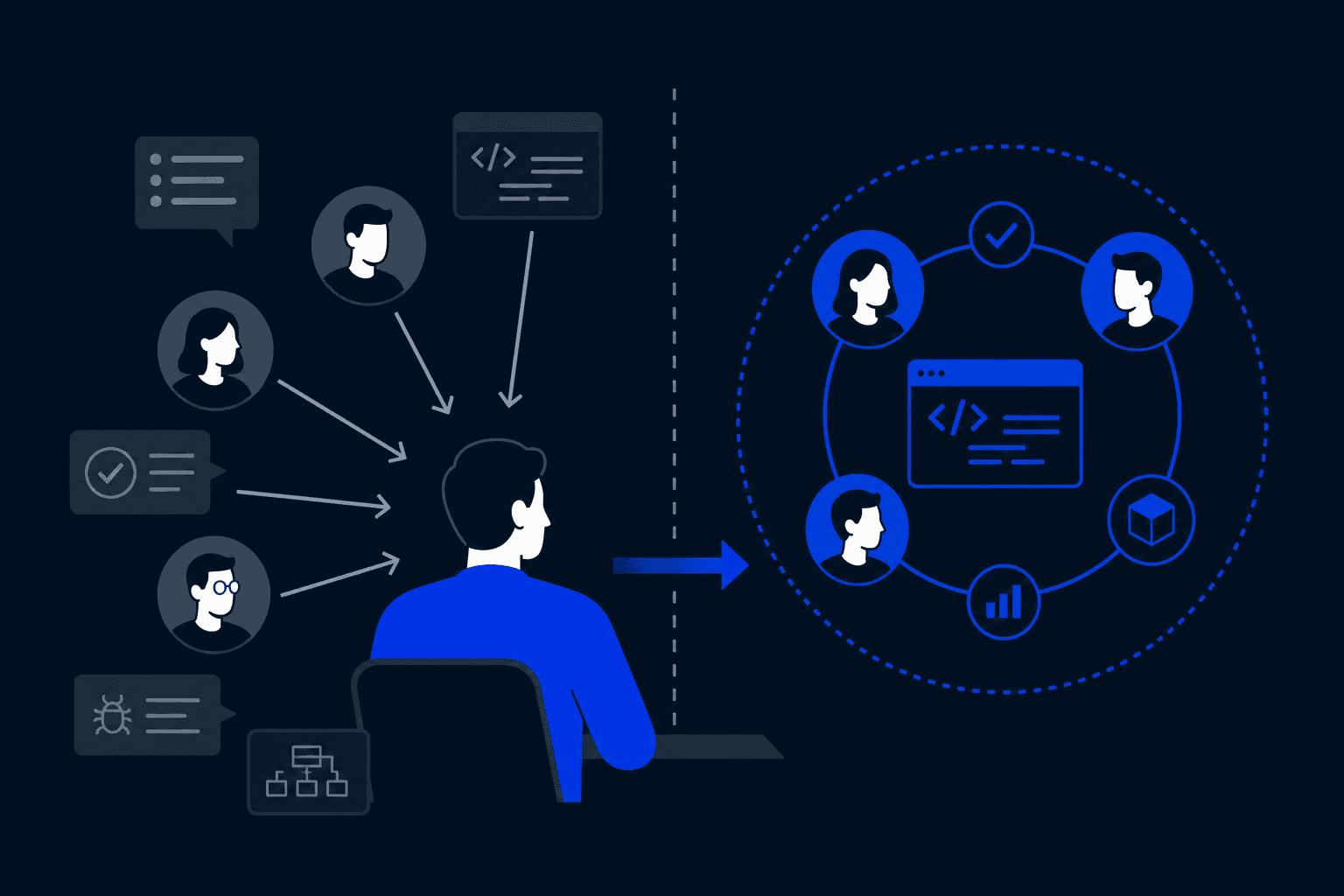
You are doing full engineering management. The capacity you added is real. The management overhead of that capacity lands on you. If you were already the bottleneck before you brought in augmented engineers, you are still the bottleneck — you have just added more work to the queue that feeds into you.
Under an Embedded Pod
Your week looks closer to this:
Weekly or async sync with the pod on roadmap progress
Reviewing a short list of decisions that require your input
Spending the rest of your engineering-adjacent time on product direction, customer conversations, or fundraising
The pod manages its own execution. You manage the pod's direction and outcomes. For a seed-stage founder who is simultaneously the product owner, the customer-facing lead, and often the fundraising lead, this distinction is not a minor convenience. It determines whether you can actually do those other jobs.
When Each Model Is the Wrong Choice
When Staff Augmentation Is the Wrong Choice
Staff augmentation fails when there is no one in-house with the bandwidth or seniority to direct and review the augmented engineers.
This is the exact situation most seed-stage founders are in. You are a lone technical founder or a CTO who already has no time. Adding engineers who need direction and review from you does not solve the problem — it scales the problem.
If your constraint is that you cannot do engineering management right now, staff augmentation makes that constraint worse, not better.
When an Embedded Pod Is the Wrong Choice
An embedded pod is the wrong choice for a narrow, well-specified, short-term task where you genuinely want hands only.
If you have strong in-house technical leadership, a clear spec, and a defined piece of work that needs execution for a fixed period, staff augmentation or freelance marketplaces like Toptal or Lemon.io are the more efficient fit. You do not need delegated ownership — you need capacity that follows your direction. An embedded pod brings process and team structure that adds overhead where you do not need it.
The embedded pod model is designed for sustained delivery across a meaningful scope, not for filling a short-term gap on a well-managed team.
The Week-to-Week Mechanics: A Comparison
Dimension | Staff Augmentation | Embedded Pod |
|---|---|---|
Architecture decisions | Client CTO/tech lead makes every call | Pod surfaces options and recommendations; client approves direction |
Standup | Engineers join client's existing standup | Pod runs its own standup; client syncs weekly or async |
Code review | Client's internal team reviews all PRs | Pod handles internal review; client reviews outcomes, not PRs |
Ticket breakdown | Client breaks down work into executable units | Pod manages its own sprint planning within agreed scope |
CTO's time allocation | Engineering management, PR review, blocker resolution | Roadmap direction, decision approvals, product and fundraising |
Best fit | Strong in-house tech lead with bandwidth to direct | Founder or CTO who needs to step back from day-to-day execution |
Wrong fit | No senior in-house capacity to direct and review | Short-term, well-specified task on an already well-managed team |
The Cost Frame
A full-time senior engineer in the UK costs upwards of £170,000 per year in total employment cost — salary, employer National Insurance, pension contributions, and benefits included. That figure does not cover a tech lead, DevOps, or QA.
Our embedded pod engagements are structured to come in below that figure, in the £5,000 to £15,000 per month range depending on pod size and scope, covering engineering, DevOps, and QA under a single retainer. The fractional CTO layer is available on top of that for companies that need architecture governance without a full-time hire.
The comparison is not pod versus one engineer. It is pod versus the full cost of building the team you would actually need to do the same work.
Diagnosing Which Model Fits Your Gap
The right question is not "which model is better." It is "what is my actual constraint right now."
If your constraint is execution capacity and you have a senior technical leader with time to direct and review, staff augmentation is a reasonable fit. If your constraint is that you are the bottleneck and you need the engineering function to run without consuming your week, an embedded pod is the right structure.
Most seed-stage and early Series A founders who reach out to WireApps are in the second situation. They have already tried to manage augmented engineers and found that the overhead landed back on them. The embedded pod model exists specifically to remove that overhead from the founder's week.
If you are not sure which model fits your current gap, a strategy call is the right starting point. The conversation covers your current team structure, your delivery constraints, and which model addresses the actual bottleneck — rather than adding to it.
FAQs
What is the main operational difference between an embedded pod and staff augmentation?
Staff augmentation adds engineers who execute under your direction. An embedded pod operates with delegated technical ownership — managing its own standups, code review, and sprint planning, and syncing with you on outcomes rather than daily execution.
Does an embedded pod replace my CTO?
No. An embedded pod works alongside your CTO or founder. It removes the engineering management overhead from their week so they can focus on product direction, fundraising, and customers. If you also need architecture governance, a fractional CTO layer can sit above the pod.
When should I use staff augmentation instead of an embedded pod?
When you have strong in-house technical leadership with the bandwidth to direct and review external engineers, and the work is well-specified and short-term. Staff augmentation is efficient in that context. It becomes a problem when there is no one in-house with the time or seniority to manage the augmented engineers.
How does code review work inside an embedded pod?
The pod handles internal code review before work surfaces to the client. Engineers review each other's PRs inside the pod. The client reviews roadmap progress and outcomes, not individual pull requests.
What size of company is an embedded pod designed for?
Seed-stage to early Series A companies that need sustained engineering delivery but cannot justify the cost of building a full in-house team. The model is designed for companies where the founder or CTO is currently the bottleneck in engineering execution.
Can an embedded pod work alongside existing in-house engineers?
Yes. Pods are designed to operate within an agreed scope alongside in-house teams. The pod handles its own delivery lane and syncs with in-house engineers at the appropriate cadence, rather than requiring full integration into your existing processes.
How quickly can an embedded pod become productive?
Because the pod brings its own internal process, standups, and review cadence, it does not need to be onboarded into your engineering management workflow. Ramp time is shorter than adding individual augmented engineers who each need direction and context from you separately.
Share


